Mastering the Midterms: Inside June’s hyper-local political ad campaigns
By
Kailee Doherty
Marketing Manager
Published
July 22, 2026
Table of contents
Welcome to Mastering the Midterms, a series dedicated to breaking down the data, trends, and shifts defining the 2026 political advertising landscape.
June marked a strategic shift in political advertising, with CTV anchoring highly targeted, omnichannel campaigns. As spring primaries wrapped up, budgets pivoted from broad statewide awareness to hyper-local June runoffs, using CTV’s high-impact screen presence to reach targeted voters.
Here’s a closer look at where political dollars went in June and the races driving the strategy.
June’s biggest battlegrounds
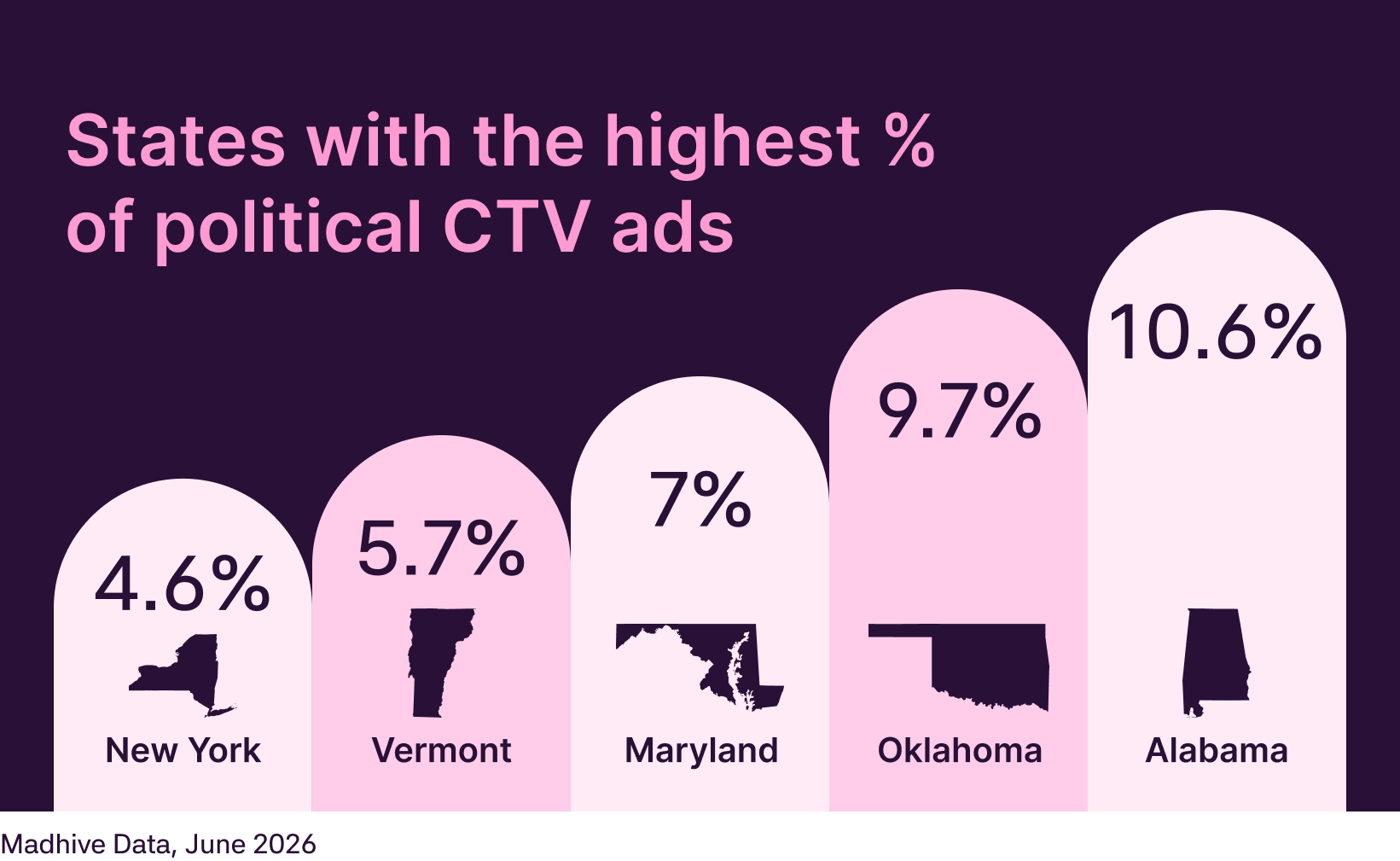
When we look at the states with the highest percentage of their overall CTV ad inventory dedicated to political ads, a clear pattern emerges: the June election calendar dictated the spend.
New York and Maryland held their state primaries on June 23, while Oklahoma held its primaries and Alabama held critical runoff elections on June 16. With the general election still months away, advertisers in these states focused on using CTV to anchor immediate multi-channel get-out-the-vote (GOTV) efforts, often matching viewing data with mobile retargeting to serve digital display and audio ads that reinforced the message right up to the booth.
District-level showdowns
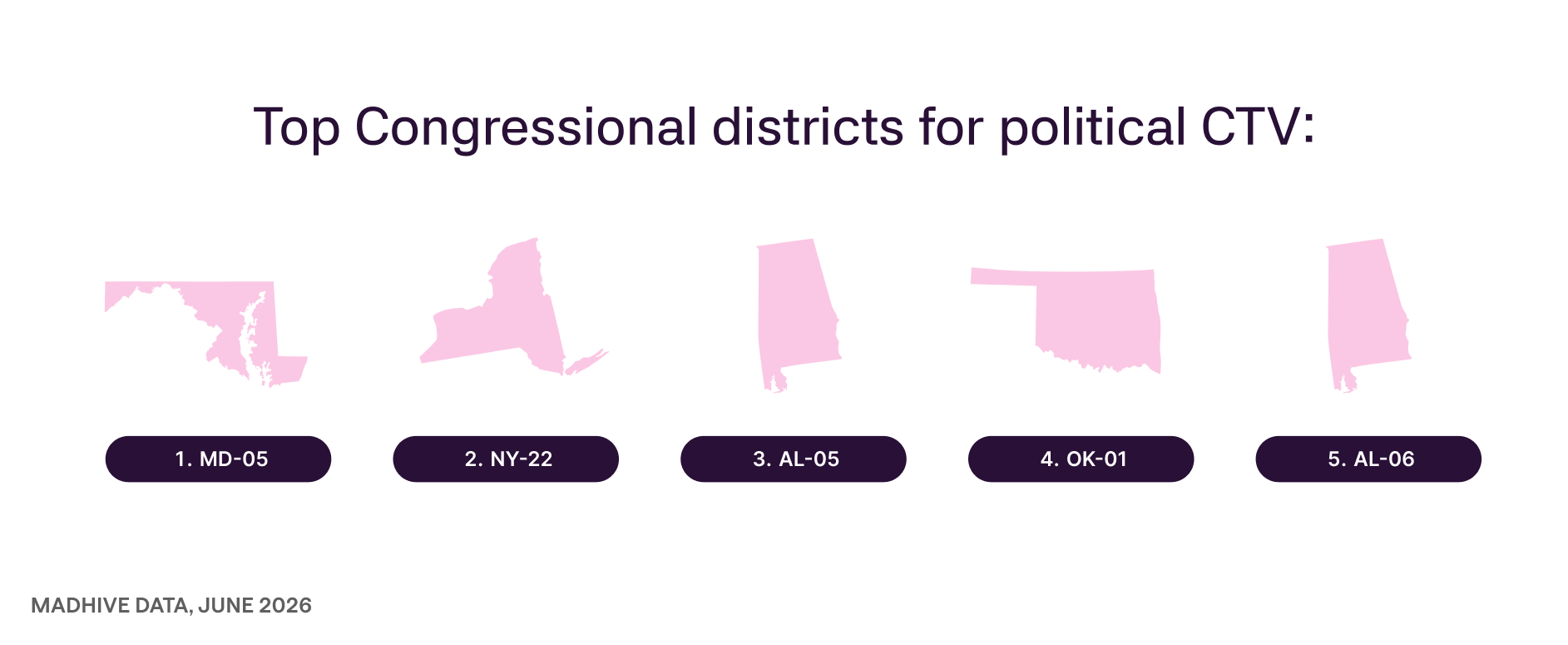
In June, the top districts for political targeting mirrored some of the most dramatic local storylines in the country, serving as the foundation for broader omnichannel campaigns.
The MD-05 scramble: Representative Steny Hoyer’s retirement triggered a highly competitive, crowded Democratic primary, creating a major surge in CTV spend as candidates raced to stand out before the June 23 vote.
Laying groundwork in NY-22: Although primaries were canceled as candidates advanced directly, heavy CTV spending continued as campaigns immediately began laying groundwork for the high-stakes general election.
Runoffs and primary battles in Alabama and Oklahoma: June 16 primaries and runoffs kept inventory active, with campaigns using zip-code-level CTV targeting to engage high-propensity voters right before they headed to the polls.
Uncovering granular behaviors with Maverick Research
Going beyond district-level totals, Madhive’s Maverick AI synthesizes multi-layered data to uncover the exact behavioral patterns driving these local campaigns. By analyzing these deeper trends leading into the summer, Maverick Research revealed several unique realities about how political budgets are deployed at the local level.
Maine households received 30x more election advertising than households in New York. A household in Bangor, Maine received $67 of political advertising compared to New Yorkers receiving just $2.21.
One Portland Maine station aired 111 election ads a day. Every day. For six weeks. Maine’s NBC station ran a political ad every thirteen minutes this summer.
Political advertising isn’t tapered on election days. It’s switched off at poll close. Campaigns aren’t easing off their ads, they stop them the moment the polls close, consistent and precise across state elections.
Key takeaways from June numbers
1. Primary spend dictates extreme budget concentration: Political budgets scale massively into hyper-concentrated saturation zones directly ahead of a primary or runoff. Campaigns must utilize platforms built for rapid, high-volume budget deployments to capitalize on these sudden surges.
2. Granular targeting is a necessity: Bypassing expensive market-wide buys in favor of precise district-level targeting (like MD-05 and NY-22) is the only way to prevent ad waste. This kind of localized budget concentration requires platforms capable of activating and optimizing at congressional district and zip code granularity rather than relying on broad regional planning.
3. Early lock-in dictates general election success: The heavy and sustained activity in districts like (NY-22) (even after primaries were cancelled) highlights the risk of delaying investment. Campaigns are securing early CTV inventory to establish a dominant message foundation with key voters long before the fall rush drives up costs and competition.
Looking ahead
July is a brief interlude, marked only by Georgia’s July 28 special election. August, however, unleashes major primary waves on August 4 (including Michigan and Washington), August 11, and August 18 (including Florida). Successful campaigns will navigate these late-summer waves by deploying coordinated, omnichannel strategies to maximize voter impact.
Catch up on previous editions of Mastering the Midterms:


.png)