Mastering the Midterms: The June primaries are reshaping where political dollars flow
By
Kailee Doherty
Marketing Manager
Published
June 23, 2026
Table of contents
Welcome to Mastering the Midterms, a series dedicated to breaking down the data, trends, and shifts defining the 2026 political advertising landscape.
As national headlines capture the broader political landscape, the groundwork for victory is paved at the local level. Political advertisers kicked their campaigns into overdrive in May, preparing for a pivotal wave of June primaries. Madhive data shows that total political impressions surged 27% month over month from April, while political household reach grew 5%.
The math is simple: campaigns aren’t just blasting the same voters over and over. Instead, they are prioritizing audience expansion, using CTV to introduce candidates and build cross-screen momentum before the summer heat hits.
Why rural states are dominating political streaming inventory
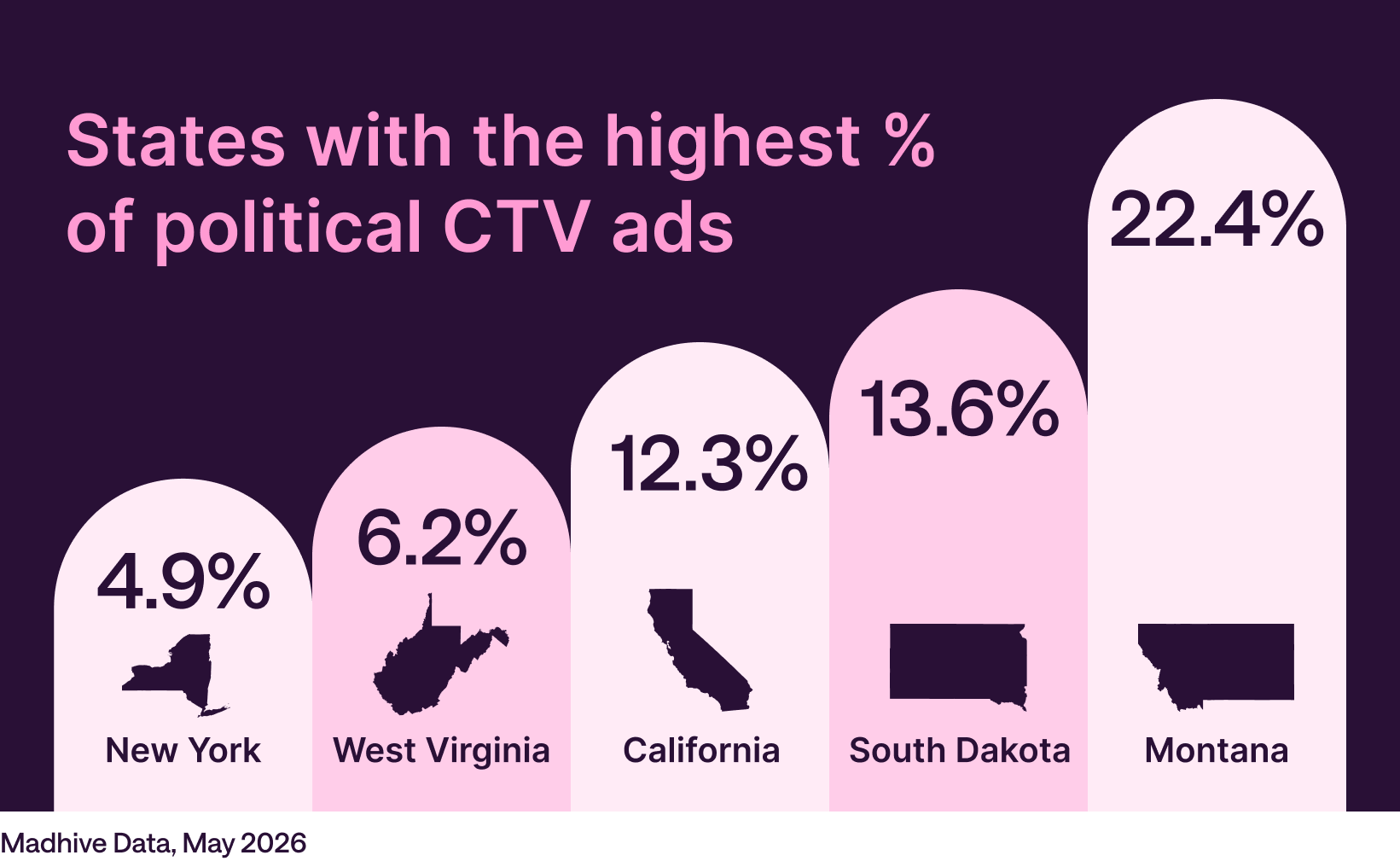
Montana topped the charts for CTV concentration in May with political ads representing a massive 22.4% of all CTV ads served in the state.
Why the sudden blitz? Montana is facing a major political shift. Voters are heading to the polls to select nominees to replace two major retiring Republicans: U.S. Senator Steve Daines and U.S. Representative Ryan Zinke. With a vast, geographically dispersed rural population, traditional physical campaigning has its limits. Campaigns are using CTV because it allows them to target households with precision, ensuring their messages land in the right living rooms across the state’s expansive terrain.
Next door, in South Dakota, political ads reached 13.6% of its CTV inventory. The primary driver is a highly competitive, multi-candidate Republican gubernatorial primary to succeed the current administration. Candidates like U.S. Representative Dusty Johnson and Lieutenant Governor Larry Rhoden are battling for the nomination, and their campaigns are leaning heavily into digital video to establish a presence in smaller, localized media markets.
The fight for the House runs through California screens
California accounted for 12.3% of the state’s total CTV ad space, fueled by a newly redrawn congressional map under Proposition 50 that has candidates scrambling.
With 52 House seats on the ballot, California is the main battlefield for control of the U.S. House of Representatives. In CA-45 (Orange County), both parties are aggressively targeting moderate suburban voters in what is projected to be one of the country’s tightest toss-up races. This intense rivalry explains why CA-45 sat near the top of the Madhive impressions list in May.
Meanwhile, Nancy Pelosi’s retirement in San Francisco has sparked a chaotic, crowded primary to replace her, driving ad volume even in historically safe districts.
Key takeaways from May numbers
1. Summer is coming and campaigns are already moving through budgets: Political impressions leaped 27% month over month. Translation: campaigns are aggressively laying the groundwork now to avoid getting drowned out in the fall, using the June primaries as a launchpad for the rest of the year.
2. Local primary states are monopolizing the streaming spotlight: Montana, South Dakota, and California saw massive portions of their CTV inventory swallowed up by political ads. Local candidate scrambles are proving that the real action is on streaming screens.
3. Casting a wide net is out, finding them where they live is in: A 5% jump in household reach means savvy media planners are ditching high-frequency models for omnichannel campaigns to capture genuine voter attention across every screen.
Looking ahead
As we cross the June primary finish line, the next phase of the 2026 cycle begins. The steady rise in both impressions and household reach shows that the most successful campaigns are not relying solely on traditional broadcast. They are building scalable, omnichannel programs that meet voters where they actually are: on their streaming devices.



.png)