Mastering the Midterms: September’s ad spend surge concentrates in small markets
By
Kailee Doherty
Marketing Manager
Published
October 13, 2026
Table of contents
Welcome to Mastering the Midterms, a series dedicated to breaking down the data, trends, and shifts defining the 2026 political advertising landscape.
In September, political ad spending intensified and narrowed to a few battleground states. With the last primaries over and November 3rd approaching, campaigns are focusing on a small group of states where a Senate seat, a gubernatorial race, and a toss-up House district share the ballot.
On the Madhive platform, political CTV impressions jumped 105% month over month from August, more than doubling in a single month. Political household reach grew 84% over the same period. Campaigns are finding more homes, and reaching each of them more often. Three key changes matter most, and they should drive every ad buy until Election Day.
Frequency is the new battleground
Impressions grew faster than reach (105% versus 84%), which means the average reached household saw roughly 11% more political ads in September than in August. That’s the classic shift from introduction to persuasion and turnout: campaigns have found their audiences, and now they’re layering on frequency. In the final stretch, the edge goes to campaigns that manage frequency carefully across households.
Targeting gets broader as Election Day nears
As November 3rd approaches, political audiences start to blur. Many campaigns loosen their targeting in the final weeks, shifting from tightly defined voter segments to broad audiences, often any adult 18+. When every unspent dollar is a missed chance to move a vote, reach starts to outweigh precision. For local advertisers, it means campaigns are now bidding on the same general inventory as everyone else, which can push up prices across the market.
Spend is pouring into small states with crowded ballots
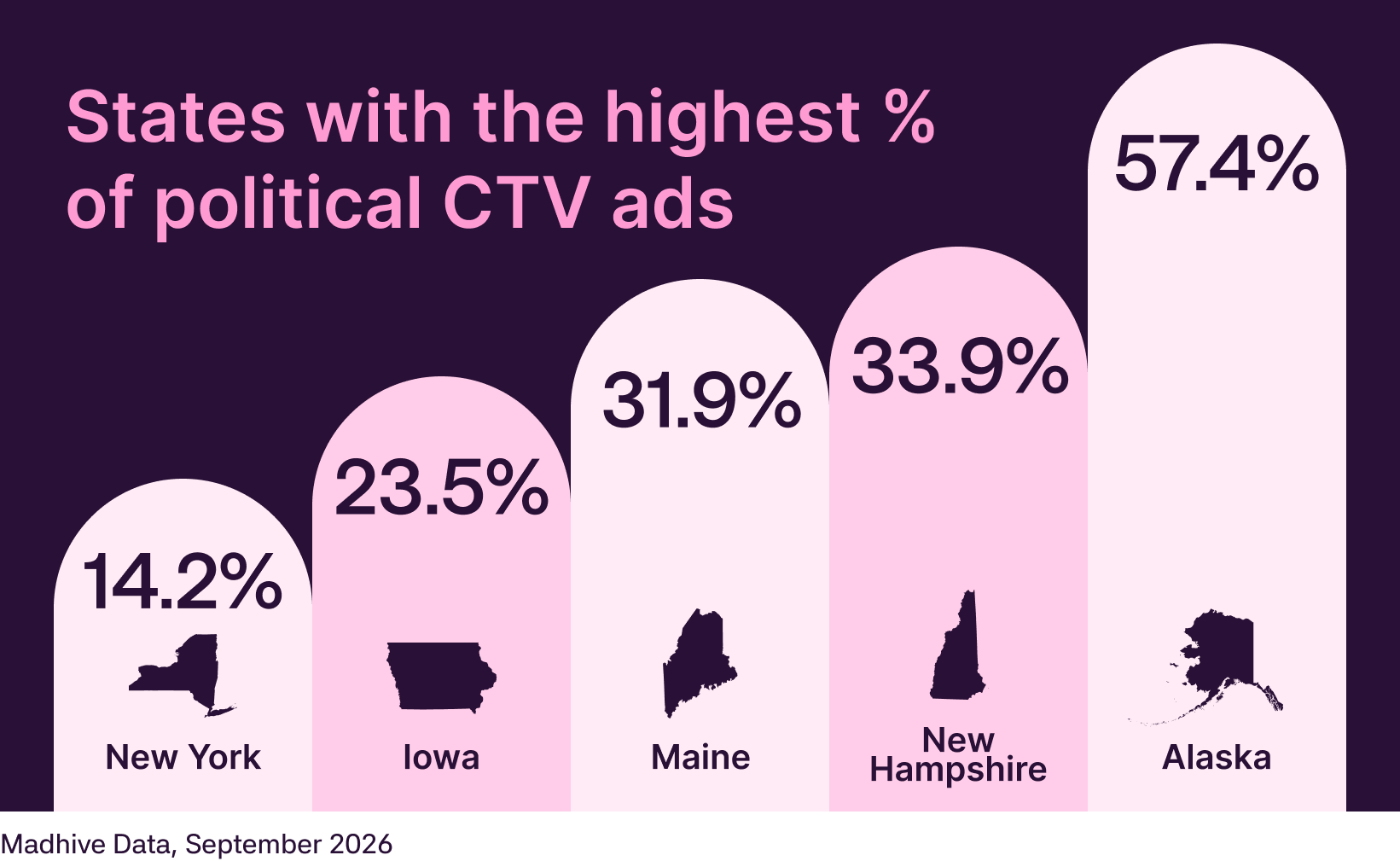
Political ads are crowding out more of the CTV landscape, and fast. In August, only Alaska saw political ads account for more than 9% of CTV ads. In September, four states cleared 20%. Here’s what’s driving each of them:
Alaska: Political ads make up more than half of all CTV ads, fueled by a Sullivan vs. Peltola Senate race that could decide the chamber.
New Hampshire: The biggest jump (8.6% to 33.9%), thanks to a near-tied Pappas vs. Sununu Senate race.
Maine: Collins vs. Platner, one of the priciest Senate races in the country, plus open governor and 2nd District contests.
Iowa: An open Senate seat, a toss-up governor’s race, and all four House districts in play.
New York: A tightening governor’s race and House seats that could decide the majority.
Down to the district
The congressional districts with the highest political CTV impressions in September tell the same story at a finer level of detail:
IA-01: A third straight matchup between Republican Rep. Mariannette Miller-Meeks and Democrat Christina Bohannan, who lost in 2024 by fewer than 800 votes.
NH-01: An open seat, layered under a toss-up Senate race and the governor’s race.
NH-02: Together with NH-01, it covers the entire state, so every New Hampshire household is in the middle of the Senate fight.
ME-02: An open, Trump-won seat that both parties see as central to House control, in the largest district east of the Mississippi.
AK (at-large): A single statewide district where House, Senate, and governor’s races all reach the same voters.
Each of these districts sits in one of our top states, where a competitive House race overlaps with a high-stakes statewide contest. That overlap turns a busy market into a saturated one, with campaigns, party committees, and outside groups all competing for the same households at once. In markets this small, premium placements go first to whoever commits early, so campaigns and local advertisers that lock in inventory now will have the most options heading into Election Day.
The persuasion window closes before November 3rd
Early and absentee voting opens in many states in October, so a growing share of votes will be cast before Election Day. Iowa starts early voting 20 days before November 3rd and New York 10 days before, which means the persuasion window closes by mid-to-late October. Campaigns that save their biggest pushes for the final week may find much of their audience has already voted, and every impression served to those households is one that could have reached an undecided voter.
The bottom line
This cycle’s political CTV story comes down to where and how often. A short list of states with stacked ballots is absorbing a disproportionate share of the volume, and the households inside them are seeing more political ads every week. For campaigns, the edge goes to whoever can secure inventory in those markets, manage frequency, and reach voters before their ballots are already in. For local advertisers, it’s a reminder that in the most contested markets, demand is setting the price, and as campaigns broaden their targeting, that demand spills into general inventory too.


%20(1).jpg)
.png)


