Mastering the Midterms: April’s political surge signals campaigns are scaling fast
By
Kailee Doherty
Marketing Manager
Published
June 5, 2026
Table of contents
Welcome to Mastering the Midterms, a series dedicated to breaking down the data, trends, and shifts defining the 2026 political advertising landscape.
April marked a major acceleration point for political advertisers. Across the Madhive platform, political CTV activity skyrocketed 40% compared to March 2026, and rose 21% year-over-year versus April 2024. Meanwhile, political household reach climbed 12% month over month.
This shift signals a move from testing to full-scale persuasion, with campaigns leveraging CTV as the anchor of their omnichannel buys – capturing attention on the big screen and retargeting across mobile, desktop, and linear to maintain frequency and unified measurement.
Virginia leads the political CTV push this month
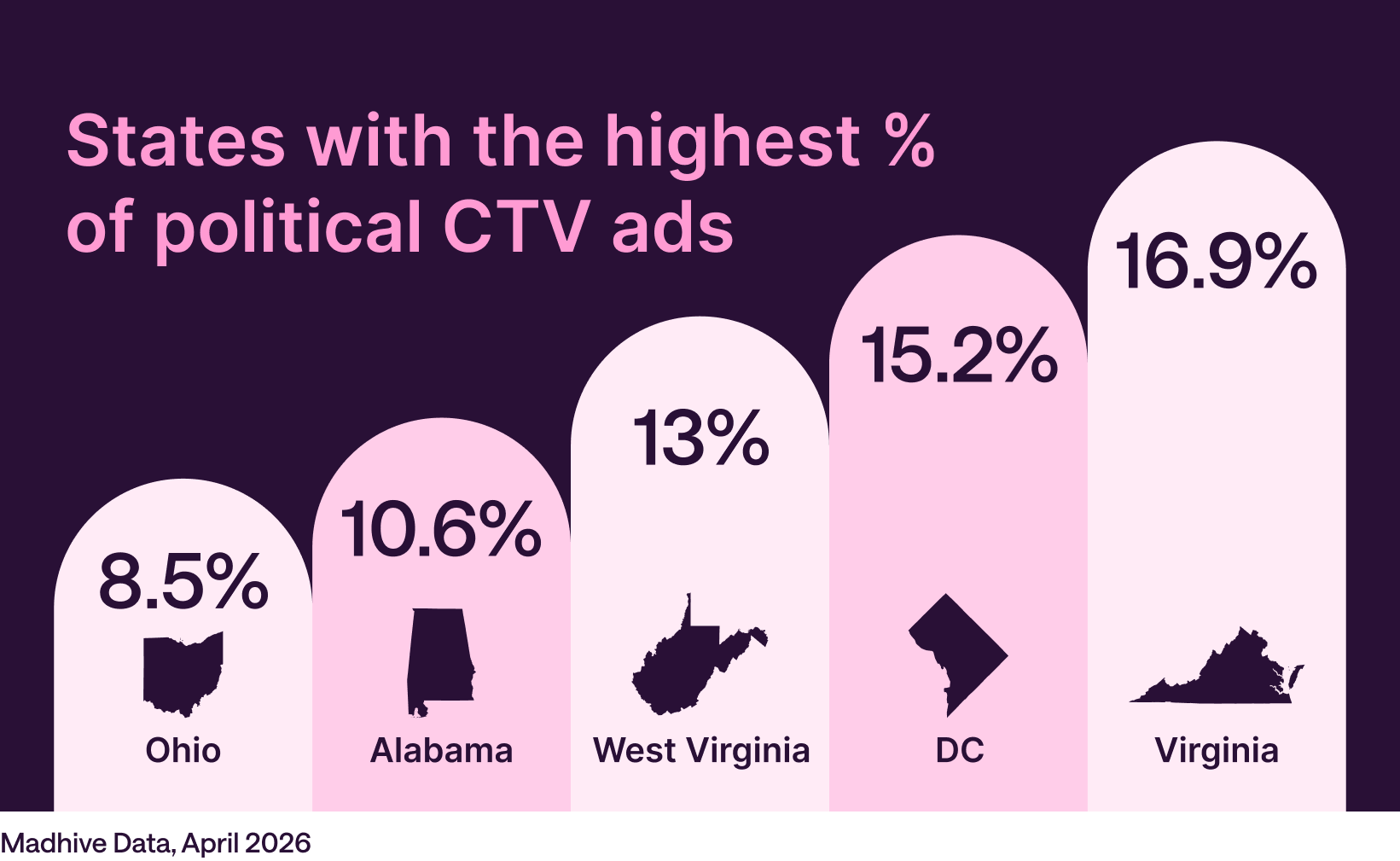
According to Madhive data, Virginia recorded the highest concentration of political advertising on CTV in April, accounting for a massive 16.9% of all CTV ads served in the state.
Several Virginia districts, including VA-03 (Hampton Roads), VA-02 (Virginia Beach region), and VA-08 (Northern Virginia), rank among the nation’s most active ad markets. Following a recently resolved redistricting battle, campaigns are deploying advanced omnichannel targeting in these key areas to reach military communities and suburban swing voters at home via CTV.
Washington D.C. followed closely behind at 15.2%. This heavy saturation is fueled by national party spending, PACs, and advocacy organizations leveraging the DC media market’s complex multi-screen landscape to reach highly mobile, politically engaged viewers and shape national narratives.
Competitive statewide races are driving early, unified media investments
Beyond Virginia and D.C., states like West Virginia, Alabama, and Ohio are seeing political advertising command a sizable share of overall CTV impressions, largely driven by blockbuster 2026 statewide races.
West Virginia (13%): Fueled by the Capito-Anderson U.S. Senate matchup and a highly active primary season, local candidates are maximizing their reach through blended linear and CTV buys.
Alabama (10.6%): With Senator Tommy Tuberville running to replace term-limited Gov. Kay Ivey, wide-open races for both the Governor and Senate seats are driving aggressive omnichannel strategies to cut through primary noise.
Ohio (8.5%): Early spending is flooding the special Senate election and the Ramaswamy-Acton gubernatorial race, with both parties working to maintain a persistent presence across voters’ daily screens.
Our data points to a broader shift in modern campaign execution: political advertisers are no longer operating in silos. They are prioritizing CTV environments earlier in the cycle as the foundation of an omnichannel approach, seamlessly extending their narratives across digital, mobile, and linear to reach voters across highly fragmented consumption habits.
Key takeaways from April numbers
1. Campaigns have officially shifted into cross-screen scale mode: April’s 40% month-over-month increase in CTV activity signals that campaigns are aggressively ramping up omnichannel voter outreach, using streaming as the launchpad for broader multi-touchpoint campaigns.
2. Virginia is a vital early battleground for holistic targeting: Virginia led the nation in political CTV saturation this month, with districts like VA-02 serving as major hubs for early, cross-device persuasion amid high-stakes local dynamics.
3. Down-ballot and open statewide races are fueling omnichannel growth: Increased activity across West Virginia, Alabama, and Ohio proves that campaigns are investing heavily in comprehensive, unified media strategies for competitive open governor’s seats and special elections early in the cycle.
Looking ahead
As the 2026 election cycle continues to heat up, the data is clear: the days of siloed political media buying are over. To cut through the noise in crowded primary and general election battles, campaigns must rely on unified, cross-screen strategies anchored by the scale and precision of CTV. By reaching voters with inconsistent messaging across every device they use, political advertisers can maximize their impact, optimize their budgets, and drive turnout when it matters most.


%20(1).jpg)
.png)


