Geofencing vs georecency: What’s the difference and which should you use?
By
Julie Jeon
Manager, Product Marketing
Published
June 2, 2026
Table of contents
Welcome to Make it make sense, where we simplify the products, features, and strategies shaping digital advertising and adtech, without oversimplifying how they actually work.
Location-based targeting sounds simple: reach people where they are. However, in practice, not all location strategies work the same way.
Geofencing and georecency are two strategies that often get grouped together, but they’re actually built for different moments in the customer journey. The former focuses on real-time presence. The latter focuses on recent behavior and intent.
Understanding that distinction changes how you target, who you reach, and what your campaign can actually prove.
What is geofencing?
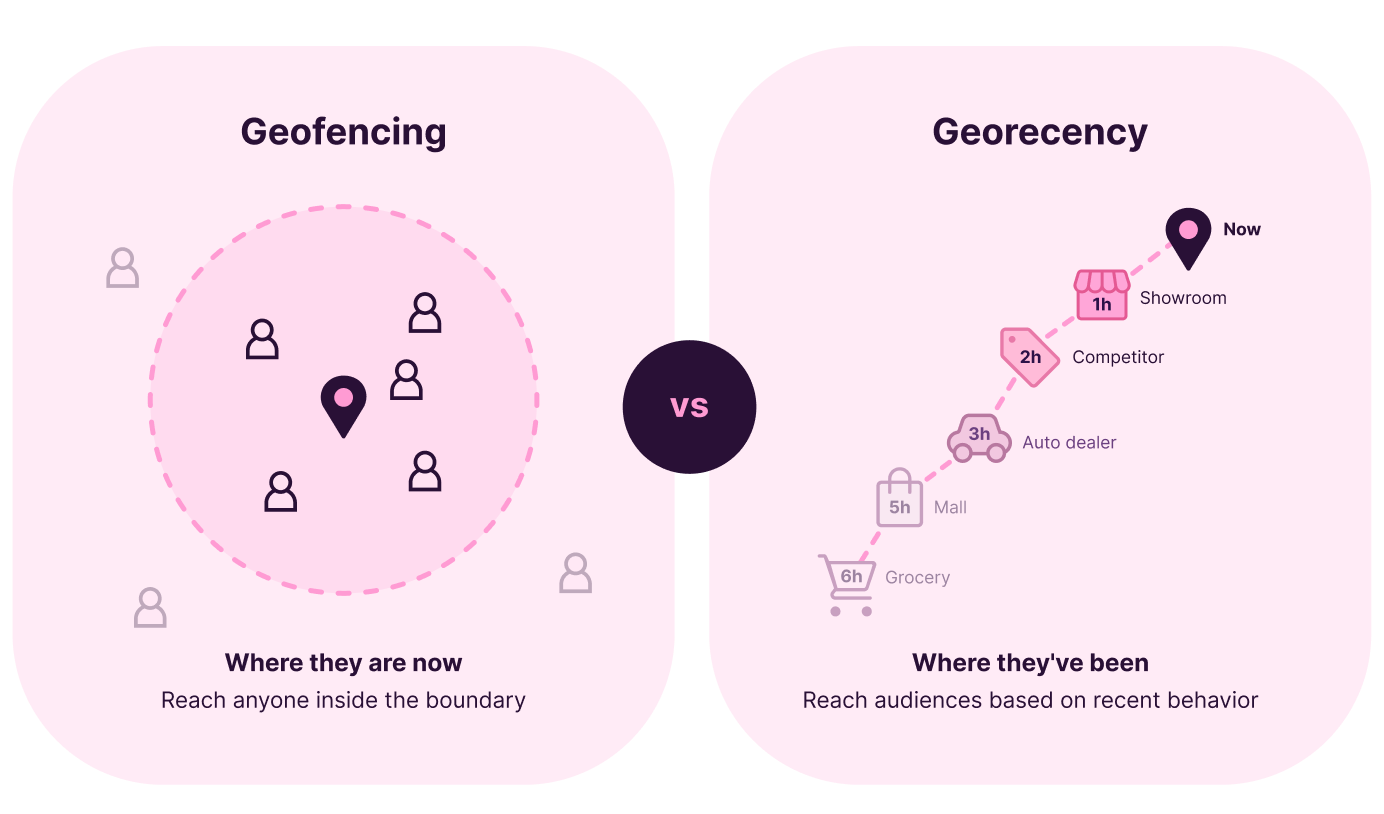
Geofencing draws a virtual boundary around a specific location, a store, a venue, a competitor's address, a custom radius, and delivers ads to users inside it at the moment. It’s hyper-local, real-time targeting: no lookback window, no behavioral history. Just precise, in-the-moment reach.
If you're a regional healthcare system or a fast food chain, reaching people who are physically near your location is exactly the right instinct. Geofencing is great for that. But it doesn't tell you much about intent.
What is georecency?
Georecency layers time onto location data. Instead of asking “where is this person” it asks “where have they been, and how recently?”
A user who visited a car dealership yesterday is a very different prospect than someone who lives near one. A shopper who walked into a competitor’s store this week is actively in-market. A patient who visited an urgent care clinic three days ago might need follow-up services. Georecency surfaces those signals and lets you act on them before the moment passes.
Georecency adds a layer of context over location data. That context is what turns a location signal into a targetable audience.
How to choose
These two strategies are built for different objectives. Using them together is possible, but it significantly narrows your targeting pool - and in most cases, one or the other is the right call.
Choose geofencing when you need hyper-local, real-time reach. You're targeting people who are physically present in a specific location right now, and immediate context is what matters.
Choose georecency when intent and recency are what you’re after. You’re building an audience based on where people have already been (within a defined lookback window) and re-engaging them with relevant messaging after the fact.
Geofencing is a top-of-funnel strategy. Georecency is a retargeting strategy. They serve different moments, and your campaign objective should drive the choice.
The use cases worth knowing
Geofencing
Local reach: deliver ads to anyone physically present within a defined radius of your store or venue.
Competitive proximity: reach people who are inside a competitor’s location right now.
Georecency
Competitive conquesting: reach audiences who recently visited a competitor’s location while they’re still actively comparing options.
Event-based targeting: engage users who attended a specific venue or event while the experience is still fresh.
Sequential messaging: adjust creative based on recency - someone who visited seven days ago gets a different message than someone who visited yesterday.
Foot traffic attribution: close the loop between campaign exposure and in-store visits using the same signals that drove targeting in the first place.
How Madhive delivers
Madhive’s platform connects location and recency signals directly to campaign delivery across CTV, OTT, OLV, audio, and mobile. Foot traffic attribution ties those signals back to real-world outcomes, so you’re not just targeting smarter, you’re proving it worked.
TL;DR
Geofencing reaches people where they are, in the moment. Georecency targets an audience that has been in a location, during a specific time interval. They work differently, serve different points in the funnel, and the best campaigns treat them as separate tools for separate jobs.

.png)


%20(1).jpg)

.png)


