How Maverick AI delivered 4x better performance for a retailer
The Challenge
Proving causation, not just correlation
A major retailer needed to drive e-commerce sales. They wanted to prove that their ads actually made people buy, not just reach people who were planning to shop. Standard campaign reporting shows correlation. They needed causation.
The Solution
Split the audience, test the difference, prove the impact
Madhive built the campaign around a holdout methodology: 85% of target audience saw ads, 15% were suppressed as a control group. Both groups were otherwise identical: same demographics, same locations, same likelihood to shop. After the campaign ran, Madhive compared what each group did. The control group established the baseline. Everything above that baseline was incremental lift driven by the ads.
Within the exposed group, Madhive tested Maverick Audiences against the retailer’s standard segments: competitive conquesting, loyal/lapsed customers, and demographic targeting. The hypothesis: behavioral signals from first-party data would outperform demographic profiles.
The campaign ran on CTV/OTT inventory. Same creative, same timing across all tactics. The only variable was how the audiences were built.
The Results
The incrementality test proved that the campaign worked
The holdout test validated casual impact. Comparing exposed vs. control, shoppers who saw ads were more likely to: - 7.78% visit the site - 7.61% add items to their cart - 8.64% complete purchases
Purchase lift was highest, proving the campaign influenced buying behavior, not just awareness.
Across e-commerce, the retailer generated: - 17.5x ROAS - $4.4M in incremental revenue From $160K in campaign spend, that’s revenue that wouldn't have existed without the advertising.
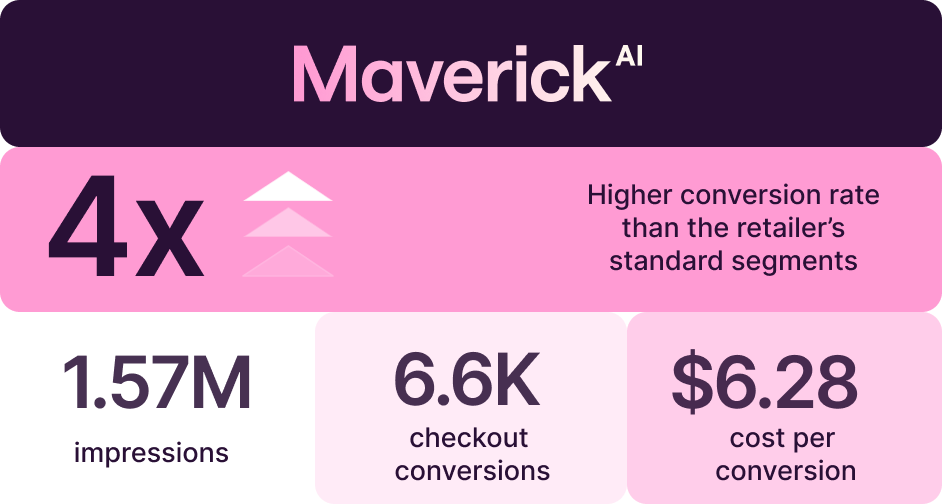
Within the campaign, Maverick Audiences outperformed every other targeting tactic. Maverick drove:
The conversion rate was approximately 4x higher than the other targeting tactics tested, proving that AI-driven audience identification beats traditional segmentation methods. These are actual completed purchases - people who saw the ad, went to the site, and bought something. While abandoned carts and site visits are important funnel metrics, these numbers represent final transactions.